Current Affairs, Movies, Life Style, Auto-motives...

Facebook
RSS
Showing posts with label Auto-motive. Show all posts

Honda electric car gets 118 mpg, but costs add up


At 118 miles per gallon, the Honda Fit electric vehicle is the most fuel-efficient in the United States. But getting that mileage isn't cheap — and it isn't always good for the environment.

Honda announced the eye-popping figure Wednesday, making the small, four-door hatchback more efficient than electric rivals like the Ford Focus, Nissan Leaf and Mitsubishi i-MiEV. It goes on the market this summer in Oregon and California.

The electric Fit has an estimated price tag nearly twice as high as the gasoline-powered version. It would take 11 years before a driver makes up the difference and begins saving on fuel.

With gas prices falling, the high sticker price for electric vehicles is becoming more of a barrier for American buyers, even though the vehicles are far more efficient than their gas-powered counterparts. That's hurting sales of electrics.

Through May, carmakers sold just over 10,000 electric vehicles, less than 0.2 percent of U.S. car and truck sales.

That's because the numbers don't add up for the average consumer.

— The electric Fit needs 28.6 kilowatt hours of electricity to go 100 miles. At the national average price of 11.6 cents per kilowatt hour, that costs $3.30.

A gas-powered automatic-transmission Fit, which gets 31 miles per gallon, needs to burn 3.2 gallons to travel 100 miles. At the national average price of $3.57 per gallon of gasoline, that's $11.52.

— People drive an average of almost 13,500 miles a year, so a typical driver would spend $445 on electricity for an electric Fit over a year, and $1,552 on gasoline for a regular Fit.

— Honda has valued the price of an electric Fit at $29,125 after a $7,500 federal tax credit. That's $12,210 more than the gas-powered Fit — a savings of $1,107 per year to make up the difference between the electric and the gas-powered version.

Customers don't want to spend the extra money up front and wait for years for payback, said Geoff Pohanka, who runs 13 auto dealerships in Virginia and Maryland, including three that sell the Nissan Leaf and Chevrolet Volt electric cars.


"People are smart. They're looking for the deal," he said. "Is somebody going to fork out $15,000 more for something that gets them less range than their car now? It's not happening."

At first, Honda will only be leasing Fit EVs in Oregon and California, for $389 per month. The subcompact seats up to five people and can be recharged in three hours with a 240-volt charging station. A fully charged Fit EV can go 82 miles, meaning a daily commute could cost nothing for gasoline.

And leases can make sense for consumers. Carmakers can lower rates and subsidize deals in order to make a car — especially one with new, expensive technology — more attractive to buyers.

Jesse Toprak, vice president of market intelligence for the car buying site TrueCar.com, said he tested an electric Chevrolet Volt, driving it less than 35 miles a day from his Los Angeles-area home to work and back. The cost of leasing it — $369 a month — is comparable to the $300 he would spend on gas.

"In a lot of these cases, I'm surprised that people are not lining up to get these things," he said.

The comparison between gas and electric cars also can vary with geography, largely because energy prices vary wildly across the country.

In Oregon, where gasoline is 18 percent more expensive than the national average and electricity is 16 percent lower, an electric Fit will save $121 per month in fuel. In Connecticut, which has the highest power prices in the country, the monthly savings are just $83.

The fuel used to generate electric power and the cost of gasoline also vary by region —and that affects how environmentally friendly an electric car purchase is.

In Midwestern states that rely heavily on coal, driving an electric car produces 18 percent fewer greenhouse gas emissions than driving a typical gasoline-powered car, according to the Union of Concerned Scientists. Surprisingly, driving an electric car there produces 50 percent more greenhouse gases than driving a 50 mpg electric hybrid.

In the Northeast and Northwest, where a bigger portion of the power is produced with nuclear reactors, hydroelectric dams, natural gas-fired power plants and wind farms, an electric car will produce 76 percent fewer greenhouse gas emissions than a typical gasoline-powered car and 56 percent fewer emissions than a hybrid.

No matter what the energy costs, Honda expects to trumpet the Fit EV's 118 mpg figure, even though it will lease only 1,100 of the cars in its first two years on the market.

Honda predicts that the initial customers for the Fit EV will won't be focusing on a cost-benefit analysis. Instead, they'll want to make a statement about cutting greenhouse gases and reducing dependence on foreign oil, said Robert Langford, Honda's manager of plug-in electric vehicle sales.

Like the rest of the auto industry, Honda isn't sure when or if electric vehicles will ever replace those that run on gas, he said. The company keeps constant watch on sales of electric cars already on the market like the Nissan Leaf and Chevrolet Volt.

"That's constantly on our mind right now and on our radar screen," said Langford.

Chevrolet doesn't actively market the Volt's 94 mpg figure, because it's too confusing to explain to consumers that the car can drive that distance while running on electricity. The Volt, unlike other electrics, has a small gas engine on board to generate power for the car after the battery is depleted.

What resonates more with consumers is that the average Volt driver goes 900 miles before buying gasoline, said Cristi Landry, the car's marketing director.

She also isn't sure when electric cars will go beyond the environmentally conscious buyer and into the rest of America's driveways.

Electric vehicles, Toprak said, won't sell en masse until customers know they will ultimately save enough to take a risk on new technology.

"You're not buying it to save the trees," Toprak said. "You're buying it to save money for yourself."

[ Read More ]

Test Drive : Volvo S60 T6 Sedan Is So Right


Anamit Sen spent a day with a Volvo S60 T6 and it brought back fond memories of another day, another Volvo.

 If you have about Rupees 35 Lakh to spend and you are planning on purchasing a new car, may I suggest you spend it on a Volvo? OK, before you all rise in consternation and start asking Volvo?? and insist that Volvos are staid, boring, safe with looks akin to a brick, staid and did you say boring, let me clarify... I'm not talking about any Volvo, see? I'm talking about the S60, the aggressive looking and driving car you see in the picture!

 My first brush with a Volvo happened a few years ago and it belonged to my cousin, a doctor in Yorkshire. It was a 480ES and I have many happy memories of swanning around the Yorkshire moors and dales in it with my cousin. That brought home to me then the fact that Volvo DID make some exciting cars apart from the usual, yes, brick-like saloons and estates. You can see bits of DNA from the 480ES car in the C30 today which sadly, Volvo has not introduced in India as yet. Fact is Volvo has been making pretty decent cars for a long time. Heck, Volvo even went racing with Tom Walkinshaw in the British Touring Car Championship with a T5 Estate of all things!

 Although I had wanted to drive the diesel version of the S60 initially I am actually very glad to have got the T6 petrol instead. The S60 is certainly a soothing balm for eyes that have become sore by looking at all the regular, unremarkable cars on the road. Externally, the S60 has very aggressive looks made even better by the stance. What gets you first are the front and rear skid plates as well as the short rear end. While four alloy rim styles are available, the T6 looks very good on the 18 inch Sleipner alloys. The man behind the S60's dynamic looks is Peter Horbury, Volvo Cars' Design Director. After a seven-year stint at Ford, the all-new S60 is his baby. According to Horbury, every single line in the design is meant to transport one both physically and emotionally. The coupe-like feeling is very strong and he feels that to make a lasting impression, there is little point playing the “polite Englishman” or “reserved Swede”. That is why the S60 is so much more daring than previous models - one has to agree, the S60 is one helluva looker. Incidentally, the S60 does not have a key – it has a Personal Car Communicator, which apart from locking and unlocking the doors also indicates when an unauthorised person is inside the car provided the PCC is within 100 metres of the car.
[ Read More ]

BMW Zagato Coupe hails the glory days of hand-built cars


For the past few years, BMW has made a habit of unveiling a new and usually daring concept car at the Concorso d'Eleganza, a classic car gathering for Europe's crustiest upper crust on the shores of Italy's Lake Como. Here, first seen in Yahoo! Autos' Motoramic, are live shots of its latest, the BMW Zagato Coupe, a first-time pairing with the Zagato design house that suggests what could be.

The Zagato name conjures images of fleet Alfa Romeos and Aston Martins among collectors, and the family has managed to maintain an independent business building limited-edition automotive bodywork while most competitors were either sold to corporations or went out of business. While BMW has called on Italian designers in the past to breathe new life into its cars -- namely in the '70s and '80s, with models such as the original M1 -- it has never worked with Zagato.


Built mostly by hand, the BMW Zagato isn't meant to suggest a production car and the two companies have no plans to build more -- but the one they did bolt together isn't a designer's dream confined to the turntable, but a coupe that can be legally driven. There's several features that hearken more to Zagatos past than any BMW, especially the glass rear hatch and faint double-bubble  roof common to all racing Zagatos, but the overall effect suggests a upper-class successor to the Z4 coupe.

Previous BMW show cars like the 328 Homage and GINA concept were never meant for production, and some BMW execs say the Zagato isn't either. Yet why build a road-ready, realistic concept only to confine it to an Italian lakeside resort once a year?

[ Read More ]

BMW M135i offers a 320-hp hot hatch with no passport: Motoramic Dash


This weekend, BMW unveiled a sorta-successor to its 1M barnstormer, the M135i, offering 320 hp and a choice of transmissions in a hot hatchback shape. It's a sharp package, and one that as of now has no plans to embark to U.S. customers. Maybe BMW should rethink its opinion about how us Yanks feel toward hot hatchbacks.


BMW's reluctance toward the M135i involves a complicated bit of marketing. The normal 1-Series hatchbacks aren't sold in the United States to begin with, in part because hatchbacks don't have a luxury pedigree among American buyers. The M135i isn't a true M-Power track monster, but a version of what BMW calls its M Performance line, an attempt to carve out space between traditional M models and its regular cars with hotted-up performance variants that still offer all of BMW's luxury comforts.


But those differences wouldn't really matter to a driver wanting a hatchback that can hit 60 mph in 5.1 seconds with the six-speed manual; the eight-speed automatic does it in 4.9 seconds. The power comes from a turbo version of the company's classic inline six engine, with maximum torque of 332 ft.-lbs. available at 1,300 rpm. And if the three-door look above seems too confining, there's also a five-door variant.


If the Subaru BRZ/Scion FR-S furor has shown anything, it's that there's a healthy demand among American car buyers for modern rear-wheel-drive performance cars. The 1M turned into such a hit some dealers were slapping $20,000 markups on the sticker. Don't keep the candy behind the counter, BMW.


Other stories this morning:


GM faces union fight in European restructuring: GM wants all its factories running three shifts a day -- but at least in Germany they still serve beer in the plant cafeteria. (Wall Street Journal)


VW rules out Formula 1 for now: (Autosport)


GM, Chrysler soar in supplier survey: Turns out treating suppliers well works better than beating on them for cost cuts and holding their payments up for months. Whocoodanode? (AutoNews)


Ferrari tops $41.8 million Monaco sale: Ancient Ferraris remain a rapidly appreciating asset class. (Bloomberg)
[ Read More ]

Rolls-Royce Phantom Series II: Motoramic Drives


"This is a long way to come for a new set of headlights," said a fellow writer as we got into our chauffeur-driven Rolls-Royce at the airport in Nice, France. "Oh, no," our driver pointed out, helpfully and probably by design, "there is much more to the Phantom."

All the real heavy lifting for this archduke's plaything occurred in the late '90s and early aughts, after BMW purchased Rolls-Royce, a once-great British label that had gathered as many cobwebs as Miss Havisham's wedding dress. The German masters imagineered the Rolls for a new generation of globe-hopping aristocracy, one that likes to drive with the power of a 453-hp V-12 direct-injection engine while also surrounded by a lacquered forest of walnut veneer and a panoply of "bespoke" luxury items. The new Phantom was a 5,600-lb. car that went 60 mph in under six seconds, with brakes that could crush coal into diamonds. Everyone loved driving it, but the car's design got Rolls in trouble. The Phantom was 19 feet long, with a hood the breadth of a football pitch. One critic compared it to a coffin. Another, "the world's most majestic air conditioner."

BMW's Rolls took these criticisms and spent the next decade swatting them away. In 2007 came the Phantom Drophead Coupé, a multi-platinum ragtop that condensed the original Phantom without sacrificing one foot-pound of torque, followed by a hard-topped grand-touring Coupé. The Spirit Of Ecstasy perched on the hood still indicated "none shall pass," but at least the Phantom had loosened up a bit, like Peter Boyle learning how to sing "Puttin' On The Ritz." Soon Rolls debuted its Ghost series, which was half the price of the Phantom, for people who enjoy the luxury and power of a Rolls but don't want to feel like they're chauffeuring a dowager countess to a royal funeral.

Now the Phantom has been massaged enough to be deemed Series II, snootier than ever, with prices starting at $400,000 and rising like a Learjet from there. In addition to an LED headlight system that changes direction as the road curves and could spot a sniper in the hills at a thousand meters, the Series II brings an eight-speed gearbox, a modern navigation screen featuring a 3D topographic map and surround-look camera systems. There's also a list of minor cosmetic updates as long as a private-dining room wine list.

But these are trifling accessories in the overall. The Rolls-Royce Phantom Series II is still essentially the same grandiloquent luxury barge that debuted nearly a decade ago. As an executive said during our mercifully short press briefing, "they got it right in 2003. Rolls-Royce doesn't do facelifts." In other words, let them eat cake.

During my high-end Rolls weekend in the South Of France, there was plenty of cake to go around.


Rolls likes to describe its brand as an avatar of "effortless luxury." To illustrate this, they treated a non-elite gaggle of car hacks to a weekend that included a wake-jumping ride in a $1.5 million Swedish-designed luxury powerboat, evenings full of unlimited after-dinner drinks, and a dinner at a Phillippe Starck-designed restaurant adjacent to Monaco Harbor. We stayed at Le Cap Estel, an elite private compound with fewer than 30 rooms, all marble flooring and soaring balustrades and top-end Cote d'Azur style. It boasts a cliffline of Mediterranean coast that would make Brigitte Bardot drool. Princess Grace used to send overflow guests when the Monaco palace was full. Discretion is the watchword there. As a Rolls guy said to us, "it's a place where celebrities can come and wear baggy clothes."

One morning I got to spend a few minutes in one of Le Cap Estel's seemingly endless series of lounges with Torsten Müller-Otvos, Rolls-Royce's CEO. A debonair gentleman in his mid-40s with a full shock of slick gray hair and nifty white suede arm patches on his sports coat, Müller-Otvos was not to the manor born. He told me that he was always a "big car nut," his interest springing from boyhood hours in a friend's garage, where they "pulled his old Beetle to bits." After many years in the BMW sales and marketing departments, he made his name by successfully relaunching the Mini around the same time BMW resurrecting Rolls. This taught him, he says, that "authenticity in a car brand is important. A brand needs to be aligned with its genes."

When I asked Müller-Otvos what his competition was, he said, "Helicopters. Jewelry. Art. Motor yachts. Sailing boats. A chalet in the Swiss Alps. No one thinks of a Rolls when their lease expires and they're wondering what sort of car they should buy. This isn't the sort of business we're in. We are in the luxury goods business. Rolls-Royce is used as a synonym for the best money can buy."

With that, it was time to motor.

A half-dozen Phantoms sat in the driveway of Le Cap Estel, polished to the inch. My drive partner for the day, a dapper 60-year-old Egyptian named Adel Murad, was eyeing a bone-white Coupé as though it were a model under an umbrella at a San Tropez beach resort.

"Let's take this one," he said. "It is the fashion this year."

But of course, I thought.


Adel took first crack behind the wheel. I sank into my burgundy-red hand-stitched leather chair, removed my shoes, and let my feet lose themselves in the plush lambswool carpet. Wood grain surrounded me. Above, the ceiling twinkled with dozens of little LED lights that had been hand-woven into the fabric. This was Rolls' famous "starlight headliner," put there as if to say, you not only own the roads when you're in this car, you also own the sky.

After a half hour, Adel handed over the reigns. This wasn't his first Rolls rodeo and he didn't need that much wheel time. In the world's most pricey Chinese fire drill, we switched in the parking lot of a gas station. My first impression was of the steering wheel, how thin, solid, and elegant it was compared with the puffed bratwursts in most contemporary cars. This, Rolls' press materials told us, is "reminiscent of elegantly engineered multifunction helms" from classic cars in the 1930s. Now under my command, the car glided away.

The seat was so low, I could barely see over the Coupé's front end. I actually had to crane my head slightly. But that didn't seem to matter. The car handled so intuitively, with such grace and power, that the scenery seemed to melt away in front of me. I'd always wondered what it was like to drive a car like this, and now I knew: Easy. The Rolls felt incredibly nimble, which surprised me considering it was as long as a city block. It floated like some sort of swan's head pontoon boat on a meandering canal. This, Adel told me, was by design. "People in this class," he said, "are never in a hurry."

The car was so big and the roads so tiny that we couldn't really fit into one lane. Backing it up, Adel later said, was like "turning around an oil tanker." But it also had enough power to tow an ocean liner, and showed its strength at every opportunity. When we hit the hills and needed the brakes and steering, both were responsive as a trusted butler.

Soon after, we drove through a village. A group of Frenchmen, busy getting drunk tableside, jeered at us and made obscene gestures as we maneuvered past them in our bone-white whale. "The French hate this car," one of the photographers told me later. "Their idea of a luxury car is old, small, and kind of rusty."

That's one of the best things about these European drives. You get to see ancient national hatreds play out in full.


After a leisurely lunch where we ate asparagus and sea bream and an elderly Frenchman played "The Yellow Rose Of Texas" on an accordion, Adel and I took the Saloon for a spin. I sat in the back, a recommended posture in the Saloon since they elevate the back 18 mm to allow for an "inspirational view." I drew the curtains closed on the side windows, removed my shoes again, turned on the starlight headliner, and breathed in rich flutes of leather.

"Ahh," I sighed.

"Even the Queen of England couldn't do any better than this," Adel said.

The road down to the coast was curvy. Adel drove very fast. I began to moan. The Rolls is famous for "waftability," a tight suspension that gives you the feeling of being rocked from side-to-side, as if on a sailboat. This works great if you're taking the princes on a seaside holiday or waving at people in a parade. But if you're horribly jet-lagged and have too much rich food, wine, and coffee in your system, something else starts to waft.

A holiday camper clogged the lane in front of us. Adel grunted and whipped the car around it. At that moment, my guts looped upward.

I'll always remember aggressively vomiting up my lunch while standing in my socks by the side of the road in the south of France. Fleetwood Mac's "Rumors" belted out of the Harmon sound system. How I hate that album. Adel looked on, concerned.

"It's better in the front, I think," he said.

Later, my constitution vaguely restored, I drove the Saloon for an hour-and-a-half on the way back to Le Cap Estel. The Phantom isn't meant for twisty roads, unless it's being driven by a villain who really needs to escape to his secret mountain fortress. But on the motorway, it's the most magnificent conveyance ever created by humans. Despite repeated warnings that the French motor cops were champing at the bit to give us tickets, I jacked it up to 95 mph without a thought. The scenery passed as though it were moving and the car standing still. At that moment, I felt -- inappropriately, since they were going to take the car away from me 15 minutes later and never let me touch one again -- like the ruler of the world.


[ Read More ]

2013 Ford C-Max hybrid priced at $25,995 in throwdown with Prius V: Motoramic Dash


Eleven years after Toyota first brought the first Prius to the United States as a hybrid-only vehicle, an American automaker has finally offered a direct reply, and based on the $25,995 base price Ford announced today for the 2013 Ford C-Max, it intends to take the fight right to Toyota.

To be built in Ford's Wayne, Mich., plant off the same assembly line as the Ford Focus, the C-Max smacks into the exact marketing spot Toyota targeted with the Prius V, whose starting price Ford was quick to note is $500 higher. On paper, the C-Max has a few advantages, including slightly more cargo space; it also shares with the Prius V the same lack of a third row that's offered to customers overseas.

And missing from Ford bragging this morning was any mention of the C-Max's actual fuel efficiency numbers, outside of a light taunt from an executive that it will cost less at the pump. The Prius V gets a combined 42 mpg, and while Ford has shown it can out-hybrid Toyota in the past, it's never sold them at volumes anywhere near what Toyota does. We'll have more when the C-Max arrives later this fall.

Other news this morning:

Alesi says he feels 'unsafe' in slow Indy Car: There aren't enough cars as it stands for capable drivers in this year's Indianapolis 500, but the continuing struggles of Lotus to even match the slowest Honda and Chevy competitors creates a safety hazard. Indy's organizers are so committed to the 33-car grid that I can imagine them pushing Alesi and Simone de Silvestro onto the starting grid if need be -- but if that's the case, and Lotus is still down 10 mph from the rest of the field next weekend, both drivers would unfortunately be wise to borrow a move from NASCAR and pull into the pits after the first green flag falls. (AP)

Chevrolet SS sedan expected this week: From the Department of Ill-Kept Secrets, GM should confirm the production of the Chevrolet SS rear-wheel-drive sedan in Australia for the U.S. of A. later this week. Wait, isn't it Friday already in Sydney? (News.com.au)

BMW CEO: "We need cool cars": The view from the top of the auto industry, also known as BMW's annual shareholder meeting. (BMW)

Subaru expands Indiana plant for Outback, Legacy boost: Subaru may be the least dramatic auto company in the world. (AutoNews)
[ Read More ]

Why the Korean boom among American carbuyers may come to an end: Motoramic Dash


No carbuilder has done a better job of luring American shoppers to their products over the past few years than Hyundai and Kia. After nearly leaving the United States in previous decades, the Korean duo now outsells Nissan, and seems capable of selling every car they can build or import. Yet a key annual study by a Wall Street analyst says that boom may be ending.

While car enthusiasts debate the merits of which automakers build more appealing models, the analysts at Merrill Lynch have held for years that over time, such measures don't matter much to an automaker's success because the stinkers and the hits average out. What really predicts success? Newness -- keeping the models on the show floor as young as possible, and having the stream of new models stay steady rather than swing wildly between bumper crops of all-new cars one year and droughts of aging metal the next.

In the annual Car Wars study, Merrill Lynch analyst John Murphy and his team found that after a few years of turmoil, the industry has converged to a point where no automaker lets many of their cars and trucks go more than four years without a major update. Between 2013 and 2016, Merrill Lynch expects Ford to pick up market share, based on its forecast of replacing models that account for 26 percent of its sales, including the F-Series pickup and a new Ford Mustang -- the highest rate among any major automaker. General Motors, Toyota and Nissan will be close behind, while Chrysler and Honda will trail the leading pack by a bit.

After a few years of revamping their entire model lines from the Hyundai Sonata to the Kia Sorento, Merrill Lynch expects the Koreans to take a breather through 2015, with fewer new, high-volume updates and a shrinking market share. It's not a radical drop -- the industry's simply too competitive for that -- but it shows that no one has a lock on what kind of cars Americans buy.

Other news this morning:

Lexus kills slow selling HS250h: This is the flip side of "Car Wars;" no matter what automakers forecast, nothing's automatic, and some ideas just don't work, like trying to sell a restyled Prius as a luxury sedan. (Autoblog Green)

Toyota expands V6 production in Alabama: Just giving people what they want. (Green Car Congress)

VW builds 360-hp Golf for Worthersee festival: That's one fast Golf cart. (Car and Driver)

GM adds 200 workers for Malibu production: The Detroit plant that builds the Volt will remain underused until the new Impala launches next year. (Detroit News)
[ Read More ]

2013 Ford Shelby GT500, a gentler stampeding Mustang: Motoramic Drives


The 2013 Ford Shelby GT500 arrives late this year fresh from its third major makeover in the last four years, Ford's master chief in its battle for pony car dominance. Thanks to an influx of beefier hardware and clever software, the Shelby GT500's performance amazes in every dimension -- almost too much so.

There's no more fitting tribute in the wake of Carroll Shelby's passing last week than to note when Ford engineers vowed that the 2013 version of the street-rocket Mustang bearing his name would hit 200 mph, Shelby accused them of "bulls**ting" him. They told the truth.

The changes wrought on the 2013 Shelby aren't just the monstrous increase in horsepower from 550 hp to 662 hp with 631 ft-lbs of torque, making the 'Stang capable of a 0-60 mph time of just 3.7 seconds. The braking system scrubs excess speed with larger, 6-piston Brembo calipers. To shed weight gained from the bored-out 5.8-liter supercharged V8 engine, Ford installed a carbon-fiber driveshaft and a plastic fuel tank. The engineers worked tirelessly on multiple cooling systems and with Bilstein on an optional performance package, bringing the suspension and handling in line with the hefty increase in power.

The front end sports a more aggressive design and a grille-free opening that contains endless fairings and flaps, increasing front down force by 66% -- crucial in getting the car over 200 mph without reviving the Mustang as an airborne object. The rear end has the new for 2013 taillights and a not-so-subtle quad exhaust producing the bellow of a waking giant.

With my car fitted with the optional "Track Pack" that increases cooling even further -- and bumps the sticker price to $65,120 from the $54,200 base number -- I took to the Road Atlanta racetrack. I braced for a punishing ride that would make me earn my lap time, and instead found a companion as calm and eager to reward as a day-care teacher. There was no understeer to speak of, and the rear was planted on power down. The gear ratios from the beefed-up Tremec six-speed manual were so long that the car tricks you into thinking you're going slower than you actual velocity. The car will do 60 mph in just 1st gear, and I was still in 3rd at 140 mph. It felt, dare I say it, tame.

And I didn't want it to.


I wanted to manhandle the car, holding my breath every turn, praying I would emerge from the other side without bending metal or myself. I worried that in their drive to wrangle this herd of wild horses, the Ford engineers had actually done their jobs too well.

The same was true when I hit the country roads. The 242 additional horsepower in the GT500 over the upgraded Mustang GT barely made its presence known -- in part because the GT500 only makes its maximum when the car "over revs" from its normal redline of 6,250 rpm to 7,000 rpm in eight-second bursts, and the tall gear ratios prevent the chiropractic snap you'd expect when nailing the gas pedal. As a cruiser, it projects all the coolness a Shelby should, but I wasn't there to prance about. I brought spare boxer shorts and I expected to need them.

The next day brought us to the drag strip, and there the spirit of Carroll Shelby emerged. The long gear ratios suddenly made sense, perfectly matched for the task of producing an 11.7-second quarter mile time, just a bit faster than the GT500's archenemy, the Chevrolet Camaro ZL1. Credit Ford's launch control system, perhaps the best on any production car today, that lets drivers pick an engine start limit by 100 revs at a time to match the conditions on the track. It was far smarter than I was, and no matter how hard I tried with the traction control turned off, I couldn't beat the system.


Carroll Shelby was famous for saying, "Whatever the competition comes up with, we're going to kick the hell out of them." In a drag race or lapping around the Nurburgring, the 2013 Shelby GT500 probably will. It's a car that Ford claim can do everything -- and back it up. It's a great car to cruise down the highway or over country roads. It can drag race with the best and can lap a racetrack like a car half its size. It's fantastic -- and yet I feel a little let down.

The Shelbys of decades past were many things, but like Carroll Shelby himself, "refined" wasn't one of their selling points. All the best of his muscle cars carried a madness that makes them magical. If you want to go blisteringly fast in a straight line and reign as the king of the stoplights, then buy this Shelby. But if you want your pony to provide a rush of adrenaline, the more unpredictable, wild Mustang GT will let you live at the limits for less money. With the GT500, you can leave your spare boxers at home.


[ Read More ]

Monster Tajima’s electric racer turns Pikes Peak into Gotham


We've mentioned Nobuhiro "Monster" Tajima's plans to tackle this year's Pikes Peak climb in a custom-built electric racer, and today Tajima revealed his ride in Japan, this carbon-fiber bodied runner powered by a yet-to-be-disclosed electric combo. Too bad it's going up a mountain, because it'd look right at home patrolling Gotham.


The Monster Sport E-RUNNER Pikes Peak Special will follow in the tracks of Tajima's record-setting run last year, the first by a driver to finish the Pikes Peak course in under 10 minutes. This year's race will be much faster thanks to full paved roads, but it's still not clear how Tajima might compete for an Unlimited class win versus 900-hp gasoline machines.

Tajima isn't the only electric entry in this year's race, with Mitsubishi entering this highly modified version of the i-MiEV electric car, which looks like a regular i-MiEV given pontoons and a 335-hp drive system, which will compete head-to-head against Tajima in the electric class. Pikes Peak may be a bit quieter this July, but it won't be less competitive.
[ Read More ]

Mercedes gold wraps fleet of cars for Cannes film festival, silencing haters forever


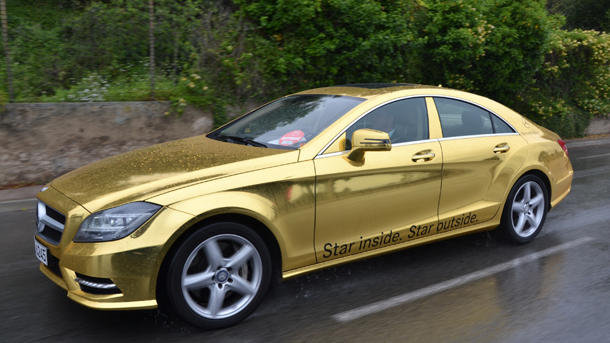
We were wrong. We were all wrong. All of us typing seagulls on the Interwebs whomever made fun of someone taking a power-up to their personal status by wrapping a car in shiny gold vinyl like a Studio 54 dancer were just misbegotten. Because this Mercedes CLS isn't some tuner's weekly paycheck, but an official product of the Mercedes-Benz company, the one that invented the automobile, created to haul stars around the Cannes film festival. I feel so schooled.

Mercedes says the fleet of limos and AMG cars offered as a shuttle service around Cannes this week mark the 65th anniversary of the Palme d'Or, the golden award given to the top film at the festival, which will probably be some twee arthouse confection since they didn't let "Battleship" screen in competition this year. By transporting movie moguls around a French resort town in Mercedes vehicles wrapped in faux-gold, Mercedes will show off the star power of its vehicles while making a subtle commentary on the fleeting nature of fame and the shallowness of public image manipulation. Or maybe not.
[ Read More ]

Ford Racing’s NASCAR Fusion shows its first colors: Motoramic Dash


Cribbing style lines from Aston Martin has only made the 2013 Ford Fusion one of the more anticipated new cars of the year. This shot of the Ford Racing NASCAR entry in its first 2o13 livery colors shows that British looks and southern-fried racing go together like fish and chips. The revamp of NASCAR's Sprint Cup cars for 2013 may be one of the best things for American car enthusiasts in years.


Spend enough time around the car sites on the Internet, and you'll easily find a thick vein of disdain for all things NASCAR, which gets unfairly portrayed as yokels watching yester-tech turn left. Never mind that every race series from Formula 1 down limits technology to keep races close, or that a top-shelf NASCAR team has as much engineering acumen as a F1 entry, or that great NASCAR drivers tend to do well in other series while champions from around the world often struggle on a big oval. NASCAR's slavish adherence to its formula turns off those who want to care about the machines as much as the drivers.

For 2013, that's changing. The engines will get some upgrades, but the Ford, Dodge and Chevrolet cars will at least look like their road-going relatives -- in theory, increasing the number of people who want to root for a team as much as a driver. And Chevrolet will even bring in a rear-wheel-drive sedan from Australia for something to sell on Monday rather than keep the Impala name on the track every Sunday. These are all good things.

Other news this morning:

California Senate approves bill for self-driving car tests: The Google self-driving car has been in Washington recently on a lobbying trip as well. (Chicago Tribune)
GM breaking ground to expand Missouri plant for new midsize pickups: GM alone among Detroit automakers thinks there's a market for smaller pickups among American truck fans. Maybe GM should aim for non-truck people. (Detroit News)
BMW replaces Toyota as world's most valuable car brand: How valuable? It's worth $24.7 billion, says a study -- although how you'd ever separate the brand from the cars remains an academic exercise. (AutoNews)
Akio Toyoda's favorite non-Toyota cars: Toyoda's enough of a car guy to rattle off several great Japanese vehicles without pause. Some auto CEOs would have trouble doing the same. (Autocar)
Why a Jeep in China costs $189,750: Jeep wants to build in China. Chinese people want to buy Jeeps. Neither will happen for at least two years. A study in the world's most inefficient market. (Bloomberg)
Chevy Volt owner says he hasn't filled up in 4,000 miles: On one hand, that's impressive. On the other hand, could he have been better off just buying an electric car? (EV News)
[ Read More ]

Green Formula 1 Williams race car so slow you can’t see it move


Flower shows are to Britain what the Westminster Kennel Club is to Yanks, and so I'd never question the skill or dedication it took to create this gold-medal winning display featuring a life-size replica of a Williams Formula 1 car -- complete with pit crew and checkered parking spot -- out of shrubs and flowers. It's not very fast, but it can claim negative carbon emissions.

It took growers King & Co. over three years to germinate this F1 car shown at the Royal Horticultural Society's Chelsea Flower Show, which included a few bits donated from the F1 team itself, including racer Bruno Senna's helmet. While the boxwood derby car was meant to honor Williams' 35 year anniversary, it also arrives days after Williams won the Spanish Grand Prix, its first F1 victory in eight years. Given that much time, think of how many cars King & Co. could pull from the weeds.
[ Read More ]

A more realistic idea of what Steve Jobs’ iCar could have been


After taking our own stab at guessing what Steve Jobs' dream of a "iCar" might have produced had he lived, Morphyne.com sent us this much more skillful render of modern Apple cues combined with the stance of Jobs' preferred ride, the Mercedes SL. Auto enthusiasts may scoff, but it's been a few decades since anyone camped out at a dealership waiting for a new model.
[ Read More ]

May 23: Bonnie and Clyde were ambushed on this date in 1934


On the morning of May 23, 1934, a posse of six police officers opened fire on Bonnie Parker and Clyde Barrow's 1934 Ford V8 on a rural country road in Bienville Parish, Louisiana, pumping approximately 130 rounds into the car and putting a dramatic end to the notorious couples' multi-state crime spree (the Barrow gang killed nine police officers and several more civilians in a series of robberies). The officers were reportedly deafened from the gunfire for several hours after the ambush. Bonnie and Clyde fared much worse.
[ Read More ]

Ford gets its blue oval out of hock: Motoramic Dash


Before the financial meltdown of 2008, Ford had been smart enough to borrow some $24 billion in cash to get through an expected downturn -- but was only able to do so by putting a mortgage on everything it owned, including the blue oval trademark. On Tuesday, Ford got its family jewel out of hock.


As spiffy as it is to have employees from Ford's Dearborn headquarters turn into a living logo, the person most responsible for the deal isn't in the picture. That would be Don Leclair, Ford's former chief financial officer, whose team spotted the storm clouds for the company in 2006, came up with the massive debt plan and sold it to Wall Street. (Leclair's worry about Ford's costs was so intense Ford Americas chief Mark Fields nearly launched a Lane Pryce/Pete Campbell-style fist fight over his proposed cuts in 2006.)


Leclair retired in 2008, after 32 years with Ford, and has stayed out of the limelight ever since. Inside Detroit there's always a running battle over whether "car guys" who get their hands greasy should be in power versus the "bean counters" in the corporate treasury. Ford can build 662-hp Mustangs and desert-raiding Raptor pickups because it didn't go through bankruptcy. The car guys might not be good at finances, but they're in debt to a bean counter on this one.


Other news from around the industry:


Tesla Model S deliveries begin June 22: Quite the week for Elon Musk. First his SpaceX rocket company successfully launches a payload to the International Space Station, and now Tesla will beat its deadline for delivering the first Model S sedans. Everything's coming up Milhouse. (Wall Street Journal)


Fiat, Mazda to make Alfa Romeo from next generation Miata: Mazda will build an Alfa Romeo roadster off its Miata platform in Japan. I don't expect this to lead to a rotary-powered Dodge minivan, but it's likely Fiat, Chrysler and Mazda will soon get much closer. (Detroit News)


Late auto loan payments fall: Good spin: Fewer delinquent loans show people making more money, spending wisely. Bad spin: Automakers have cut back on sales to people with less than sterling credit. (Detroit Free Press)
[ Read More ]

How yesterday’s show cars become today’s crusher bait


Every year automakers conscript dozens of tuning shops into cranking out hundreds of overdone show cars, as a form of advertising for both sides. Here's what happens when those cars are no longer needed for publicity, and the only place they can drive is the nearest crusher.

Credit Brian Fox, the Pennsylvania-based chief of Fox Marketing and a long-time customizer of Lexus vehicles, for being upfront about the destruction of two of his creations last week. Back in 2008, Fox Marketing had created this burnt-orange version of the Lexus IS-F sedan for the Specialty Equipment Market Association show with new bodywork and hopped-up engine good for more than 600 hp.

When automakers provide tuners with a car for a show like the IS-F, they're often doing so before the car goes on sale -- which means they're handing over pre-production vehicles that by definition can never be licensed for street use under U.S. law. A few SEMA survivors pop up every year in auto auctions, but often sell for far less than their modifications cost because they're furniture rather than a moving vehicle.

Most simply aren't collectible enough to justify saving, and after removing the parts that can be reused or sold, they meet their ends as an expensive piece of recycling.
[ Read More ]

Test Drive : BMW X1 - Riding Roughshod on BMW X1

BMW X1

Anamit Sen addresses a long-pending matter by driving a BMW X1and coming away with good thoughts.

I have a small confession to make - As an automotive photographer and writer I've experienced a wide variety of cars from quite a few international manufacturers like Porsche, Ferrari, Jaguar, Mercedes,Audi, VW and more. But there are quite a few I have not driven but wanted to and at the top of that list was BMW. Was, because I've just been introduced to BMW through what is the 'einsteiger' or the entry model in the X Series, the X1. BMW says that the X1 offers a completely new driving experience in the premium compact segment while helping to increase the range of BMW X models made famous by the X5, the X3 and the coupe-on-an-SUV X6. In India, BMWoffers the X1 in three variants – one petrol (sDrive 18i) and two diesels (sDrive 20D and sDrive 20D Exclusive) with differences in trim and specs. Both entry-level variants in petrol and diesel are priced very competitively at Rs 22,40,00 and Rs 24,40,000 respectively while the Exclusive diesel-only version is priced much higher at Rs 30,40,000 (all prices Ex-showroom) but comes with a whole host of features including a panoramic roof.

In terms of looks the X1 is rather impressive. I looked at it from every conceivable angle - head-on, above, crouched low, front and rear three-quarter from above and below as well as the profile. The head-on view immediately tells you that this is a BMW, a muscular one at that, thanks to that trademark grille and the headlights staring you in the face while from the rear it is quite car-like. It's only when you see it in profile that you start thinking it is more beefed-up estate than SUV which immediately endears the car to me. BMW says the body design is intended to exude self-confidence, elegance, versatility mixed with a bit of an agile, sporty character. To me, the X1 looks quite unlike anything else on the road and this is helped by the fact that we don't have too many estates running on our streets. The X1 has a length x width x height (in mm) of 4454 x 1798 x 1545 and a wheelbase of 2760mm. The track at front and rear was 1500 and 1529mm respectively and the turning radius was 11.3m. The X1's boot capacity is 420 litres but can be increased to a maximum of 1,350 litres if required. An electrically operated Panorama glass roof is also available for the X1 xDrive20d Exclusive.

[ Read More ]

Test Drive : BMW 330i - Temptation on Wheels

BMW 330i

Anamit Sen spent a whole day evaluating a BMW 330i in and around Delhi and the NCR. I'm starting this review with a bit of news. Auto Bild magazine in Germany has just reported that the 2012 version of BMW's 3 Series, which will be the 6th generation of the 3 Series, is ready to be showcased at the Frankfurt Motor Show later this year. The reports say that this new BMW, classified internally as the F30 and going up against the Mercedes C Class, Audi's A4 and Volvo's S60, has borrowed quite a bit in terms of design from the 5 Series. It will break new ground in terms of safety and will have new four-cylinder turbocharged engines. The reports also says that though BMW may not be vorsprung durch technik (borrowing from Audi) or advanced/ahead through technology any more because competitors also have the equivalent of the advantages of Efficient Dynamics, the boffins DO have access to the parts and accessory shelf of the 5 Series. Which means it is quite possible that the F30 may offer features like night vision assistance, heads up display or HUD, lane changing assistance as well as automatic parking.So how is that bit of news relevant to this driving impression? Well, if you have not noticed yet the car featured here is the BMW 330i Edition Sport, internally classified as the E90. OK, let me explain the internal classification over the years, which starts way back in 1966 when the 1600-2002 series came in as a family saloon. It was sporty too with an 80bhp engine that could reach 96kph in 13 seconds. The 2002 Turbo was part of the 02 Series, with a 170bhp engine and BMW churned these out till 1976. The internal E classification kicked off with the E21 ,the first generation of 3 Series cars, production of which ran from 1976 to 1982. These cars still used small engines, with capacities of 1.6 and 1.8 litres. BMW introduced their first six-cylinder engine in the 3 Series at the Frankfurt Motor Show in 1977, the 323i which had 143bhp on tap.The E30 that followed in 1983 was the second-generation 3 Series. These cars were bigger than the previous generation cars, had more power, but were lighter, the perfect recipe for performance. The 325i topped the range and had a straight-six engine developing 170bhp out of 2.5litres, good for 135mph or 216kph which would be adequate even today. The E30 was especially notable because it was the base for the first M car, known simply as the BMW M3 E30, launched at the Frankfurt Motor Show in 1985. This particular car was VERY successful in race trim, winning several touring car championships. The M badge had arrived.

[ Read More ]

Test Drive : Toyota Liva - Spunky Little Runabout

Toyota Etios Liva

Ever since I saw it at the 2010 Auto Expo, where the Liva (along with the Etios) had been displayed as a concept car I've been waiting for the Liva to set the cat amongst the pigeons. Yes, Toyota does havehatchbacks in it's product portfolio globally but it doesn't have one in it's India portfolio. Until now, that is. Which meant that the company was missing out on a very key segment of the Indian market. The Etios saloon came first and it was adequate but didn't really set one's imagination on fire. All it did was to get most people who drove it remember the Maruti Esteem in terms of dynamics and some thought it looked like a bit like the Renault (Dacia) Logan. The Liva on the other hand was expected to be launched in April 2011 but various factors including the major disaster that affected Fukushima and Japan.

Just as Etios is a derivation of the Greek word Ethos which means spirit, character and ideas, Liva has been derived by combining the words and the intention - Lively and Live Life to the fullest. This also tells you who the car is targetted at, today's youth whose spirit and belief influences the advertising line for the Etios Liva -“LIV TOMORROW TODAY”. Toyota likes to do this in India – remember the Qualis?

Etios Liva is available in four variants, J, G, V and VX, and the pricing ranges from Rs 3.99Lakhs to Rs. 5.99 Lakhs, ex-showroom Delhi. Toyota says the Liva has several USPs that will endear the car to buyers – These include youthful and sporty design, best-in-class cabin space, superior ride comfort and best-in-class fuel efficiency. Toyota has attempted to impart a stylish, sporty and trendy look by offering the Etios Liva with aero kits with front, rear and side skirt. The sporty flat-bottomed steering wheel is another plus as is the 2 DIN audio system with Aux in, USB and a wireless remote.

Toyota says that the Etios Liva has been designed around the concept of ‘Bold Simplicity’. Dunno about that but from the front the Liva is very Etios-like . The same front dominated by the smiling grille and Toyota logo has been replicated here. Standing next to the B pillar looking back, I'm reminded of the Micra but while the Micra's hatch is slanted forward a bit aggressively, this one is upright. The profile view is that of any other hatch in the segment give or take a line here and a curve there.

[ Read More ]

Nissan Micra Diesel: Road Test and Review

Don't judge a book by its cover. This is exactly what I was thinking while test-driving the Micra Diesel over the weekend. Nissan Micra may be a tiny car for many, but only in the appearance. It is as big as, or even bigger than, any other contender in the segment. The diesel variant powered by a mighty 1.5-litre 63bhp unit borrowed from the Renault Logan, makes the diesel Micra a cute little monster indeed.

And it's worth the customers wait — especially those who ask for the diesel variant as soon as the petrol version is launched. Thankfully, Nissan didn't keep its customers waiting too long. Within six months of the petrol variant launch in the Indian small car market, Nissan introduced the diesel variant. At first glance, you will hardly see any difference between the petrol and diesel Micras. But, the diesel variant comes with 15-inch alloy wheels and rear spoilers, which are missing in the petrol variant. Inside, it gets leather wrapped gear-knob and steering wheel with a chrome logo on it. Otherwise, everything else remains the same.

Nissan is offering two diesel variants — XV and XV Premium. Interestingly, both sport all exciting USPs of Micra such as Push Button Ignition, Keyless entry, Auto-fold door mirrors and driver air bag. The lower variant just lacks the 15-inch alloy wheels, auto air conditioning, rear spoiler and fog lamps. One big disadvantage of the diesel Micra, though, is that it doesn't have ABS even as an option. To cut further costs, Nissan has also decided not to offer passenger airbag on the diesel variants. Looks like safety measures aren't top of mind this time.

Driving Experience

But such minor deterrents can be quickly forgotten once you experience the drive in this little monster. Simply push the Ignition button and the car comes to life not with a roar, but with a whisper. Yes, you can barely hear the engine inside the cabin. Although there's a fair amount of turbo lag as you start moving, things change in seconds and the Micra flies like a champ. You'll be amazed at the lightness of the power-steering at just 9.3 metres turning radius, which makes city-driving fun.

Under the curvy bonnet is the 1.5-litre CRDI K9K Diesel Engine that delivers 63bhp at 4000rpm and 160 Nm of torque at 2000rpm. It is mated to a 5-speed manual gearbox. The gearshifts are moderately smooth but the clutch is tougher compared to the petrol Micra. The third gear, however, offers a wide enough power band which translates into less gearshifts in city traffic.

On the highway, the car is a true performer as it seamlessly goes past 140 km/h but after that the engine starts gasping on to a maximum speed of 170+. However, the Micra is incredibly stable even at higher speeds, thanks to good aerodynamics brought togetherby the uniquely shaped cabin with a slightly raised roof end, plus rear spoiler. The compact suspension built for the V-platform absorbs plenty of punishment meted out by our roads although there is some amount of body roll and thumps and thuds. Braking is not that great, either.

The most disappointing part of the Micra is its rear seat. Although the car offers best-in-class leg, shoulder and headrooms, the seats lack proper cushioning, thigh and shoulder support. There is no head support, either. Nissan needs to seriously re-look at this feature, I'd say.

Nissan Micra is a package of many 'firsts' and best-in-class features, so one isn't surprised at the breakthrough in terms of fuel efficiency. Leaving all its contenders behind, the diesel-powered Micra delivers 23.08kpl (ARAI certified) — which essentially means one tankful will probably last you till the end of time.

The XV variant is priced at Rs 5.58 lakh while the XV Premium will cost Rs 6.04 lakh (ex showroom, Delhi).

[ Read More ]